# Understand the scores
Equal eval weights. Visible unknowns. One final percentage per model.
## Three averages, in order
1. Repetitions → criterion
2. Criteria → eval
3. Evals → benchmark %
### aggregation
```text
criterion score = mean(repetition scores)
eval score = mean(criterion scores in this eval)
benchmark score = 100 × mean(eval scores)
```
An eval with more criteria does not get more benchmark weight. Each eval contributes equally to the final percentage.
## Change a decision. See the score.
### Score explorer
Illustration · one repetition per criterion
| Eval | Criterion | Score |
| --- | --- | --- |
| SQL query | Asks for dialect | Pass |
| SQL query | Bound parameters | Fail |
| Issue summary | Actionable summary | Pass |
Benchmark score: **75%** · Equal eval weights
Select a decision to cycle through pass → fail → unknown. The calculation uses OpenEval's score projection.
[Score explorer](https://openev.al/docs/scoring/#try-it)
> **Completion bounds**
>
> Unknown values leave a possible final-score range. These are completion bounds, not confidence intervals. A known failure contributes zero and is still a scored check.
## Read each number in context
| Viewer value | Interpretation |
| --- | --- |
| Final percentage | All required criterion scores have known values |
| Checks scored | Criterion scores across evals and repetitions |
| Eval drilldown | Individual criterion scores for one selected eval |
| Runtime | Union of active execution intervals; overlapping work counts once |
| ETA | Estimate for scheduled work using candidate and judge stage timings |
| Cost | Reported candidate and judge spend; ≥ marks a lower bound when some runs have no final cost |
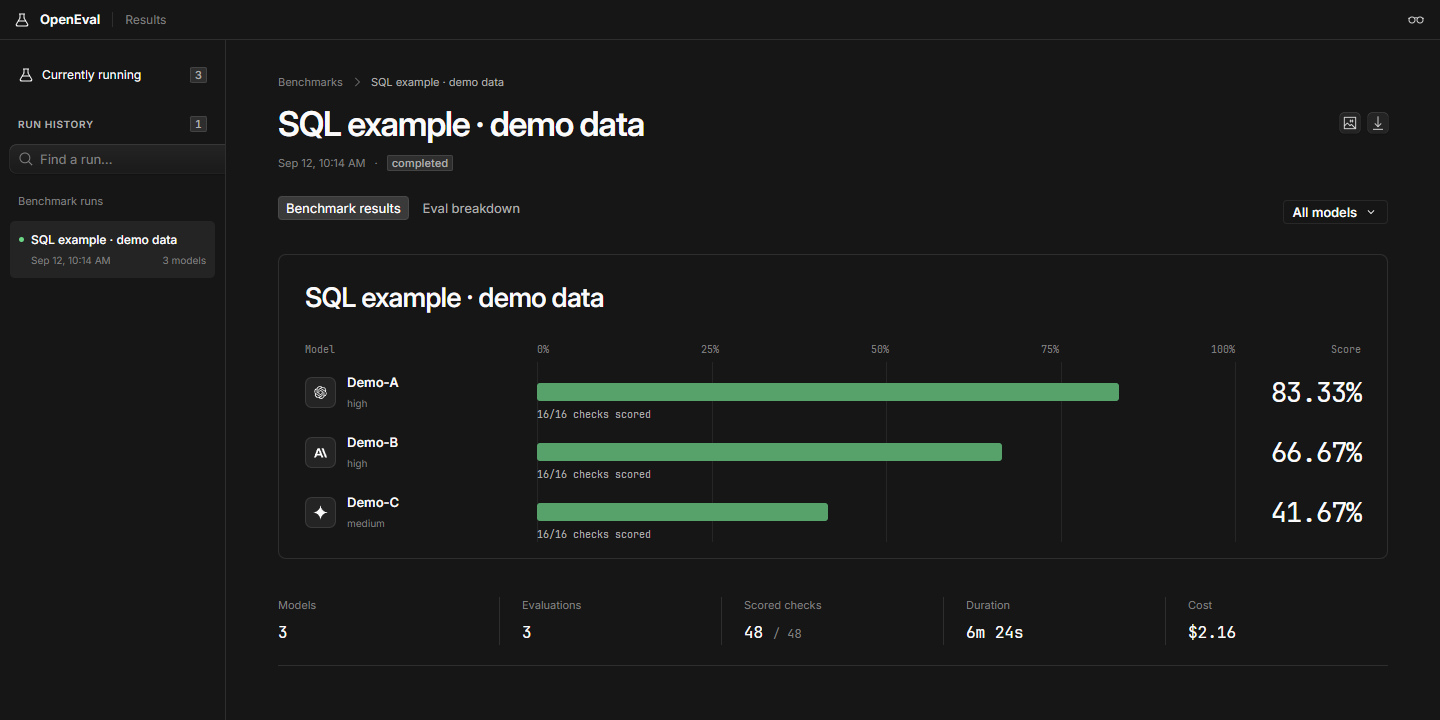
Illustrative viewer data. Every model has one benchmark score.
[Documentation index](https://openev.al/llms.txt)